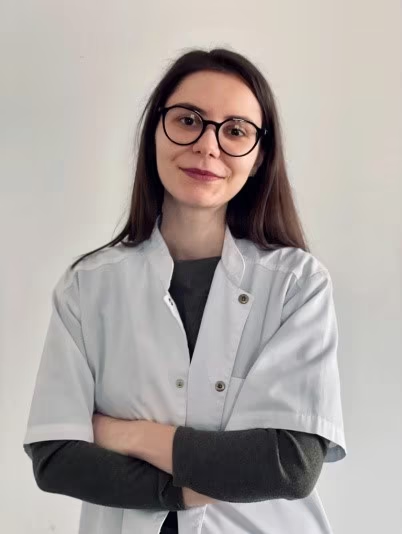

As part of our short series highlighting expert perspectives from our faculty, we spoke with Dr Iulia Pirga, a medical doctor and PhD candidate in endocrinology based in Craiova, Romania, who was recently nominated as a touchENDOCRINOLOGY Future Leader 2025.
In this interview, Dr Pirga reflects on this year’s most significant advances in endocrinology, the challenges that continue to shape the field, and the expanding role of artificial intelligence in clinical practice and research.
What do you see as the single biggest challenge facing your specialty today?
The first challenge that comes to mind is the growing burden of obesity and its complications, such as type 2 diabetes, cardiovascular disease and fatty liver disease. Despite clear evidence, obesity is still not consistently recognized as a chronic disease by patients and even some clinicians, which delays prevention and treatment efforts. While new therapies are available, including GLP-1 receptor agonists and dual incretin therapies, their high cost and limited reimbursement make them inaccessible to many patients. In these conditions, I believe that it is important to focus on prevention, education and health policies, which requires effort and constant implication.
What development this year has had the biggest impact on your clinical practice?
Here I will also mention the expansion of GLP-1 receptor agonists and dual incretin therapies for the management of obesity and type 2 diabetes. Their utility goes beyond glycaemic and weight reduction effects, proving also significant cardiovascular and renal protection, which are key elements when it comes to metabolic health. With ongoing research, I am positive that metabolic disease management will enter a transformative era and that the future is highly promising.
What excites you most about the potential of AI in your field?
I believe that with the help of AI we can improve early detection and risk prediction, thus offering a more individualized approach to our patients. By combining data from health records, imaging or genetics, AI can help us build a bridge towards personalized medicine. Moreover, AI-assisted imaging, such as in thyroid ultrasound, will become a useful tool in the future, by improving diagnostic accuracy and consistency while reducing variability between clinicians.
If you could give one piece of advice to early-career HCPs entering the field now, what would it be?
My advice is to always remain curious. Endocrinology is a complex specialty, with strong interactions with fields such as cardiology and gynaecology, and it is constantly evolving. As a result, there are multiple opportunities to engage in research on fascinating and diverse topics, from metabolic disease to rare endocrine disorders, which makes the field both challenging and rewarding. And above all, always remember to treat the patient as a unique individual. Our role is not only to treat the disease, but to provide care with the same respect and compassion we would wish for ourselves.
Disclosures: This short article was prepared by touchENDOCRINOLOGY in collaboration with Dr Pirga. No fees or funding were associated with its publication.
SIGN UP to touchENDOCRINOLOGY!
Join our global community today for access to thousands of peer-reviewed articles, expert insights, and learn-on-the-go education across 150+ specialties, plus concise email updates and newsletters so you never miss out.