
We are delighted to announce Dr Jonathan Mertens as a touchENDOCRINOLOGY Future Leader 2026, recognized for his emerging contributions to diabetes, metabolic health and translational endocrinology research.
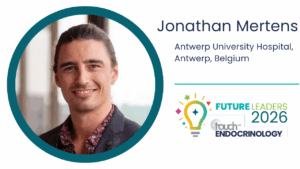
Dr Jonathan Mertens is an endocrinologist and researcher at Antwerp University Hospital and the University of Antwerp, Belgium. His research focuses on diabetes, insulin resistance, and metabolic liver disease.
Dr Mertens’ clinical and research interests focus on diabetes, insulin resistance and metabolic liver disease, with a particular emphasis on preventive medicine, patient empowerment and the integration of technology into endocrine care. An active member of the European Society of Endocrinology (ESE), he has served as Secretary of the Young Endocrinologists and Scientists (EYES) Committee and has played a leading role in the EndoCompass initiative, helping to define future priorities for endocrine research across Europe.
Inspired by the complexity of hormonal physiology and the highly personalized nature of endocrine care, Dr Mertens combines a passion for patient-centred medicine with a strong commitment to scientific discovery. In this interview, he reflects on the mentors who have shaped his career, discusses the innovations transforming diabetes care and metabolic health, and shares his perspective on the future of endocrinology.
New insights are added regularly, covering a broad range of subspecialties and evolving clinical scenarios. Sign up below for Free Access to the latest clinical updates in your specialty!
What inspired you to pursue a career in endocrinology?
I was initially drawn to endocrinology because of its logical and almost mathematical physiology, particularly the complexity of hormonal feedback systems.
During medical school, I had the opportunity to shadow consultations in endocrinology quite early in my training, and that experience immediately confirmed my interest in the specialty. I was fascinated by how personalized endocrine care is. Successful treatment depends not only on understanding the disease, but also on understanding the patient behind it.
I have always been passionate about preventive medicine and patient empowerment. In diabetes care especially, educating patients and giving them the tools to manage their condition can truly improve long-term outcomes, and that patient-centered approach is what continues to inspire me in endocrinology.
Lastly, I always had a specific interest for research. It was visible from the start that the level of science, both in endocrinology and diabetology, is very high, but also very rewarding, looking at the recent major milestones in scientific advancement.
Who has been the most significant mentor or role model for you, and what did you learn from them?
Professor Christophe De Block has been my primary mentor since the very beginning of my academic career. He is my PhD and clinical supervisor, and I will soon be joining his staff, so I expect our collaboration in research to continue, given our shared scientific interests. A large part of what I have achieved so far is due to his continuous trust and support. He combines high scientific standards with a strong sense of detail and perseverance, always aiming to bring work to the highest level of quality. At the same time, he has a very human approach: he is attentive to individual limitations, respects periods of difficulty, and understands the realities of academic work. Beyond research, he has also been an important role model in clinical practice and in academic leadership, particularly in how to balance patient care, scientific ambition, and departmental responsibilities. On a more personal note, we also share a passion for cycling, which has further strengthened our connection.
I would also like to mention Professor Sven Francque and Professor Eveline Dirinck, who have both been key mentors in my development. While Professor De Block has particularly influenced my scientific drive and endurance, both Professor Francque and Professor Dirinck have strongly shaped my approach to structuring research projects. They have taught me the importance of strategic planning, prioritization, and sustainable time management across multiple projects and responsibilities.
What current innovations in the field excite you the most?
What excites me most in endocrinology is the increasing integration of clinical care and technology. Hybrid closed-loop systems are a particularly promising development, as they are transforming glucose management and moving us closer to more automated and adaptive diabetes care. I am also very interested in the broader shift towards metabolic health, where we are moving from generic lifestyle advice towards more personalized, data-driven interventions that integrate nutrition, physical activity, and behavioral factors into tailored care plans. Finally, I am particularly encouraged by the growing evidence base around exercise in diabetes care and its gradual integration into routine clinical practice, which aligns closely with my own interest in sports, physical activity and preventive medicine.
More content in diabetes.
Cite: Dr Jonathan Mertens on driving innovation in diabetes and metabolic endocrinology: touchENDOCRINOLOGY Future Leader 2026. touchENDOCRINOLOGY. September 2026.
Disclosures: This short article was prepared by touchENDOCRINOLOGY in collaboration with Dr Jonathan Mertens. No fees or funding were associated with its publication.
Editor: Carla Junkier, Editorial Director.