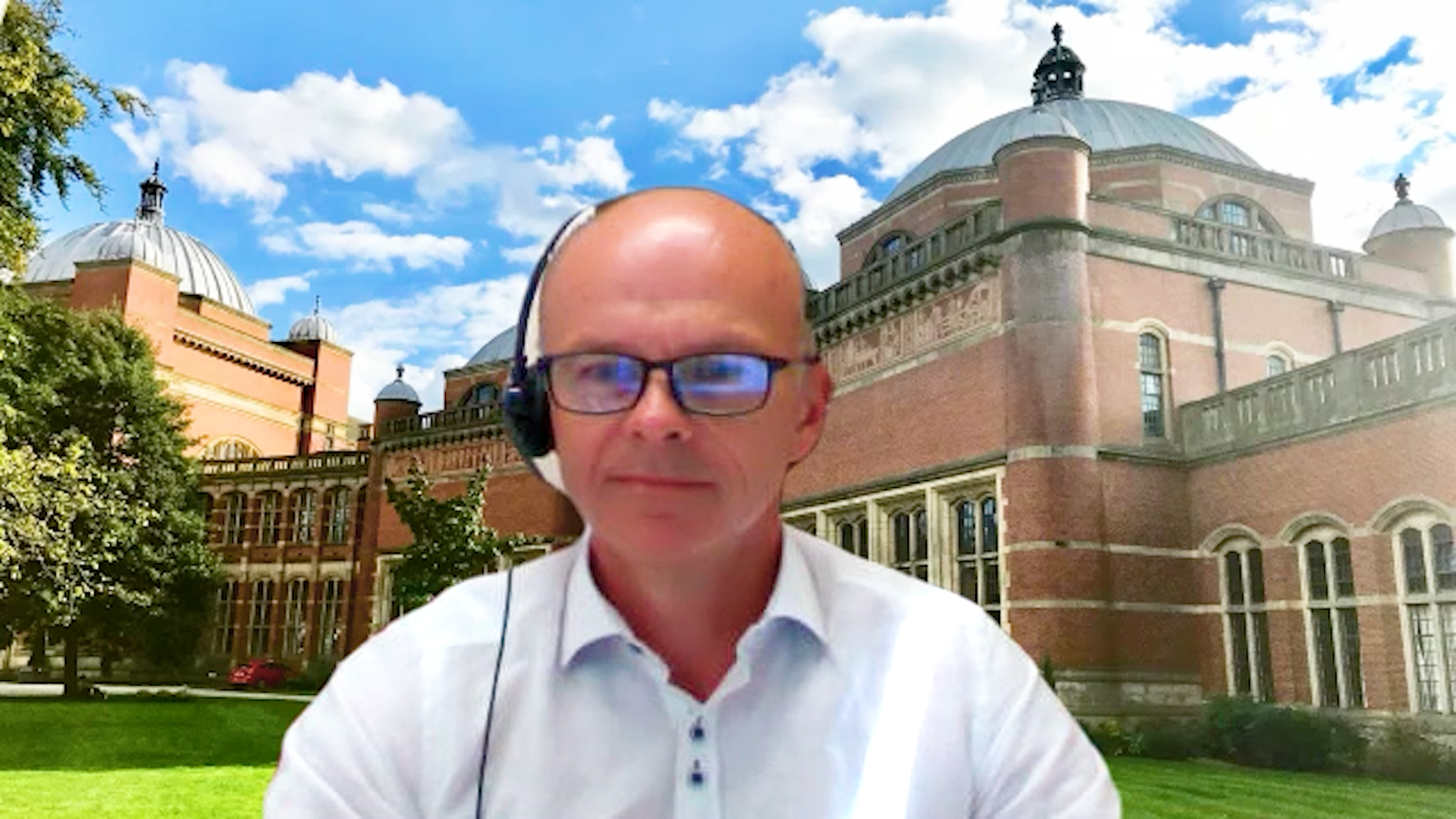
We are delighted to announce Dr Rimesh Pal as a touchENDOCRINOLOGY Future Leader 2026, recognized by his peers as an emerging leader in endocrinology and metabolic bone research.
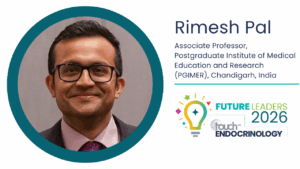
Dr Rimesh Pal is Associate Professor of Endocrinology at the Postgraduate Institute of Medical Education and Research (PGIMER), Chandigarh, one of India’s premier tertiary-care academic institutions. His clinical and research interests span osteoporosis, sarcopenia, metabolic bone disease, and diabetes. As Principal Investigator of the landmark Chandigarh Urban Bone Epidemiological Study (CUBES), he led research that established India-specific diagnostic thresholds for osteoporosis, sarcopenia, and sarcopenic obesity, benchmarks that have subsequently informed clinical practice and research in the country. Dr. Pal has also made significant contributions to the field of diabetic bone disease. His work has been recognized with several prestigious honors, including the Rising Star in Endocrinology Award from the American Association of Clinical Endocrinology (AACE) in 2026, the Young Investigator Award from the American Society for Bone and Mineral Research (ASBMR) in 2024, and the A.R. Sheth Award from the Endocrine Society of India in 2023.
In this interview, Dr Pal reflects on the factors that inspired him to pursue endocrinology, the mentors who have shaped his approach to clinical practice and academic medicine, and the enduring importance of careful clinical examination in an increasingly technology-driven era. He also shares advice for the next generation of endocrinologists, emphasizing curiosity, analytical thinking and the value of pursuing meaningful research regardless of geographical or resource constraints.
New insights are added regularly, covering a broad range of subspecialties and evolving clinical scenarios. Sign up below for Free Access to the latest clinical updates in your specialty!
What inspired you to pursue a career in endocrinology?
I have always been deeply interested in internal medicine, and one of the reasons endocrinology appealed to me was that, despite being a super-speciality, it remains a natural extension of internal medicine. It requires broad clinical thinking, careful history taking, pattern recognition, and analytical reasoning across multiple organ systems.
Another aspect that fascinated me early in my training was the diagnostic elegance of endocrinology. As a medical student, I used to dream of being able to diagnose patients the moment they entered the clinic. Endocrinology often offers exactly that experience; many endocrine disorders have characteristic physical features and clinical presentations that allow a strong diagnostic impression at first glance, which I continue to find intellectually rewarding.
I was also drawn to the fact that several endocrine disorders are highly treatable and in most cases, completely curable. Patients may present in a profoundly debilitated state, yet return to normal life following appropriate diagnosis and treatment. Witnessing such dramatic clinical transformation is immensely satisfying and is perhaps less commonly encountered in some other streams of internal medicine.
Who has been the most significant mentor or role model for you, and what did you learn from them?
I have been fortunate to learn from several outstanding mentors throughout my training and career. I remain deeply grateful to my teachers at the Postgraduate Institute of Medical Education and Research (PGIMER), including Prof. Subhash Varma, Prof. Sanjay Bhadada, Prof. Pinaki Dutta, and Prof. Anil Bhansali, all of whom shaped my approach to clinical medicine and academic endocrinology in different ways.
One of the most valuable lessons instilled during my training was the importance of meticulous history taking and a thorough head-to-toe clinical examination, principles that remain indispensable in endocrine practice despite rapid technological advances. More than any individual achievement, observing my mentors’ clinical discipline, academic rigor, humility, and commitment to patient care has profoundly influenced me. Their guidance further taught me the importance of mentoring younger colleagues and fostering collaborative academic environments, values that I hope to carry forward throughout my own career.
I am also grateful to my patients, who have been the greatest source of learning throughout my journey. Every patient interaction has contributed not only to my clinical understanding, but also to my growth as a physician.
Last but not the least, I remain deeply indebted to my parents, my wife, and my family for their unwavering encouragement, understanding, and support throughout every stage of my journey.
What advice would you give to medical students or young professionals considering a career in endocrinology?
Endocrinology is an intellectually rewarding specialty that offers a rare balance between clinical medicine, physiology, and research. For medical students and young professionals considering this field, I would encourage them to cultivate curiosity and develop a strong foundation in clinical medicine, because endocrinology often requires careful observation and analytical thinking.
At a time when medicine is increasingly driven by sophisticated investigations and technology, it is equally important not to lose the art of meticulous clinical examination. A thorough history and careful head-to-toe examination remain indispensable in endocrinology and frequently provide the most important diagnostic clues even before laboratory confirmation.
I would also encourage trainees not to feel limited by geography or resource settings. Meaningful clinical research and impactful academic contributions can emerge from any part of the world when driven by curiosity, discipline, collaboration, and commitment to patient care.
Most importantly, endocrinology offers the privilege of building long-term relationships with patients and making tangible improvements in their quality of life through thoughtful and compassionate care.
More content in bone disorders.
Cite: Dr Rimesh Pal on improving osteoporosis and sarcopenia care through research and clinical innovation: touchENDOCRINOLOGY Future Leaders 2026. touchENDOCRINOLOGY. September 2026.
Disclosures: This short article was prepared by touchENDOCRINOLOGY in collaboration with Dr Pal. No fees or funding were associated with its publication.
Editor: Carla Junkier, Editorial Director.