This website is intended for healthcare professionals only

Trending Topic

3 mins

Trending Topic

Developed by Touch
Mark CompleteCompleted
BookmarkBookmarked

Welcome to the summer 2026 issue of touchREVIEWS in Endocrinology. In this issue, we bring together articles that reflect the evolving complexity of endocrine and metabolic disease, while highlighting the growing importance of patient-centred care, translational science and interdisciplinary management. We open the issue with a timely commentary by Huajing Ni et al., which examines […]

Metabolic Syndrome in Older Adults: When Function Trumps Numbers

Marcio José Concepción-Zavaleta, Eduardo Cabellos-Acuña, Jenyfer Maria Fuentes-Mendoza, José Paz-Ibarra
4 mins
Share
Facebook
X (formerly Twitter)
LinkedIn
Via Email
Mark CompleteCompleted
BookmarkBookmarked
Copy LinkLink Copied
Download as PDF
Published Online: Sep 22nd 2025 touchREVIEWS in Endocrinology. 2025;21(2):2–4 DOI: https://doi.org/10.17925/EE.2025.21.2.6
Select a Section…
1

Abstract

Overview

This editorial critiques the limitations of traditional metabolic syndrome criteria in older adults, arguing that age-related changes in body composition, vascular stiffness and frailty render standard thresholds inadequate. Highlighting the ‘obesity paradox’ and risks of intensive blood pressure/lipid control, the article advocates for a frailty-centred approach integrating functional status, body composition (e.g. dual-energy X-ray absorptiometry) and inflammation markers over rigid numerical targets. Practical strategies include sarcopenia screening (SARC-F), resistance training and individualized glycaemic/blood pressure goals to avoid overtreatment in frail patients. The paradigm shift aims to improve risk stratification and align care with geriatric priorities.

Keywords
2

Article

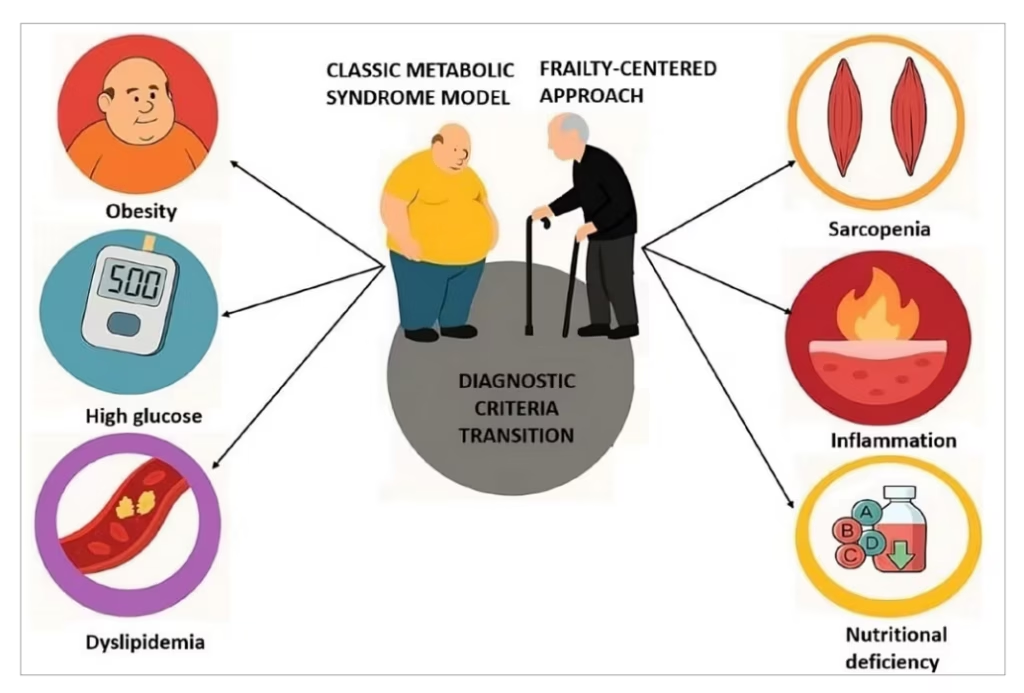
The metabolic syndrome (MetS) construct, while valuable for middle-aged populations, shows critical limitations when applied to older adults. Traditional criteria emphasizing waist circumference, blood pressure, lipids and glucose fail to capture the complex interplay between ageing physiology and metabolic dysfunction.1,2 This oversight becomes clinically significant when considering that up to 30–40% of older adults with normal body mass index (BMI) have sarcopenic obesity, a condition where muscle loss coexists with excess adiposity.3,4 The consequences are profound: sarcopenic obesity confers a 2.6-fold higher risk of physical disability compared with obesity alone; yet, it remains invisible to standard MetS diagnostics.5 These gaps demand a paradigm shift towards frailty-centred assessment, where functional status and body composition take precedence over rigid numerical thresholds (Figure 1).

Figure 1: Transition from the classical metabolic syndrome model to a frailty-centred approach in older adults
The limitations of current MetS criteria become especially apparent when examining anthropometric measures. While BMI thresholds identify obesity in younger populations, ageing alters body composition in ways that render BMI misleading for older adults.3 This limitation is particularly significant in Asian populations, where lower BMI thresholds (≥27.5 kg/m² versus ≥30 kg/m² in Caucasians) indicate equivalent metabolic risk due to ethnic variations in body composition.5,6

Sarcopenic obesity (the combination of low muscle mass and high adiposity) has been shown to be a stronger predictor of mortality than BMI alone in the elderly.3 For clinical assessment, dual-energy X-ray absorptiometry scanning provides comprehensive body composition analysis, while in resource-limited settings, practical alternatives include calf circumference (<31 cm) or handgrip strength (<27 kg for men/<16 kg for women) as validated screening tools for sarcopenia risk.4

Standard anthropometric markers fail to capture sarcopenic obesity, a key driver of disability in ageing populations. Epidemiological studies highlight this disconnect through the ‘obesity paradox’, where older adults with BMI around 28 kg/m² (the point of lowest mortality risk in Mendelian randomization studies) sometimes outperform normal-weight peers in survival outcomes.7 This paradox stems from BMI’s inability to differentiate muscle mass from fat mass, particularly seen as a problem in ethnic groups with distinct body composition phenotypes. Together, these findings demand ethnicity- and age-adjusted approaches to metabolic risk assessment.

Similar challenges apply to other MetS components. Hypertension management based on universal targets (<130/80 mmHg) derived from middle-aged trials may be inappropriate for older adults with vascular stiffening and impaired cerebral autoregulation.8 While trials like the Systolic Blood Pressure Intervention Trial Senior (SPRINT-SENIOR; ClinicalTrials.gov identifier: NCT01206062) showed increased adverse events (including falls and renal complications) in vulnerable subgroups, as shown in subgroup analyses, the Hypertension in the Very Elderly Trial (HYVET; ClinicalTrials.gov identifier: NCT00122811), targeting <150 mmHg, demonstrated both safety and cardiovascular benefits of moderate control.8,9 This clinical dichotomy supports individualized targets (e.g. <140–150 mmHg systolic in frail patients) that balance vascular protection with functional safety.

The ‘lipid paradox’, where low cholesterol correlates with higher mortality in the oldest adults, suggests that lipid levels may reflect frailty and inflammation rather than cardiovascular risk in this population.10 These nuances underscore why metabolic parameters must be interpreted through the lens of biological age and functional reserve.

Frailty provides the missing link in this assessment. Defined as decreased physiological reserve and resistance to stressors, frailty captures the intersection between metabolic dysfunction and functional decline.11 The Fried frailty phenotype, incorporating unintentional weight loss, exhaustion, slow gait, low physical activity and weak grip strength, identifies vulnerability that the traditional MetS criteria miss.11 Critically, detecting pre-frailty (e.g. 1–2 Fried criteria) enables early interventions like protein supplementation and resistance exercise, which may prevent progression to full frailty.12 Importantly, frailty and MetS share underlying mechanisms, particularly chronic low-grade inflammation (‘inflamm-ageing’) and insulin resistance.13 Elevated inflammatory markers like interleukin (IL)-6 and C-reactive protein (CRP) not only drive muscle catabolism but also exacerbate metabolic dysfunction, creating a vicious cycle that accelerates both frailty and cardiometabolic decline.14 This biological synergy explains why older adults with both MetS and frailty face 2.7-fold higher mortality than those with either condition alone.15

Practical implications of this frailty-metabolism interplay are most evident in therapeutic decisions. Where middle-aged MetS management emphasizes aggressive glycaemic control and statin therapy, geriatric care requires balancing metabolic targets against functional preservation.16 While tight control should be avoided, persistent hyperglycaemia (>200 mg/dL fasting) accelerates cognitive decline and disability; individualized goals (glycated haemoglobin 7–8.5%) based on frailty status are recommended.17 Resistance exercise combined with protein supplementation, for example, may improve muscle mass and insulin sensitivity more effectively than medication intensification in sarcopenic older adults.16

Similarly, deprescribing antihypertensives or statins may be appropriate in frail patients where polypharmacy risks outweigh potential benefits.18 The Screening Tool of Older Persons’ Prescriptions/Screening Tool to Alert to Right Treatment (STOPP/START) criteria provide a framework for such medication optimization, though clinical judgement remains essential.19 Emerging tools like the Cardiometabolic Index (CMI), which integrates waist-to-height ratio with lipid profiles, may eventually bridge metabolic and functional assessments but require validation in diverse geriatric populations.20

Moving forward requires the development of validated, integrated screening tools that combine functional assessments (gait speed or SARC-F), accessible body composition measures (calf circumference or bioimpedance) and metabolic-inflammation markers (waist-to-height ratio or CRP), with adjustments for ethnic-specific thresholds in diverse geriatric populations.13,17 These tools should undergo rigorous testing across clinical settings, from specialized geriatric units to primary care in resource-limited regions, while maintaining predictive validity comparable to gold-standard methods. The Clinical Frailty Scale offers a simple way to incorporate frailty assessment into routine metabolic evaluations.21

In conclusion, the traditional MetS framework serves younger populations well but falters in geriatric care. By integrating frailty assessment with metabolic evaluation, clinicians can better identify high-risk older adults and tailor interventions that prioritize function and quality of life. This evolution aligns with geriatrics’ core principle: adding life to years, not just years to life.

3

References

List View
Grid View
1
Copy DOIDOI Copied
Visit DOI Link

 Reaven GMRole of insulin resistance in human disease (syndrome x): An expanded definitionAnnu Rev Med1993;44:12131. DOI10.1146/annurev.me.44.020193.001005.

2
Copy DOIDOI Copied
Visit DOI Link

 Grundy SMCleeman JIDaniels SRet alDiagnosis and management of the metabolic syndrome: AAmerican Heart Association/National Heart, Lung, and Blood Institute scientific statementCurr Opin Cardiol2006;21:16. DOI10.1097/01.hco.0000200416.65370.a0.

3
Copy DOIDOI Copied
Visit DOI Link

 Batsis JAMackenzie TABarre LKet alSarcopenia, sarcopenic obesity and mortality in older adults: Results from the National Health and Nutrition Examination Survey IIIEur J Clin Nutr2014;68:10017DOI10.1038/ejcn.2014.117.

4
Copy DOIDOI Copied
Visit DOI Link

 Cruz-Jentoft AJBahat GBauer Jet alSarcopenia: Revised European consensus on definition and diagnosisAge Ageing2019;48:1631. DOI10.1093/ageing/afy169.

5
Copy DOIDOI Copied
Visit DOI Link

 Baumgartner RNWayne SJWaters DLet alSarcopenic obesity predicts instrumental activities of daily living disability in the elderly. Obes Res. 2004;12:19952004. DOI10.1038/oby.2004.250.

6
Copy DOIDOI Copied
Visit DOI Link

 WHO Expert ConsultationAppropriate body-mass index for Asian populations and its implications for policy and intervention strategiesLancet2004;363:15763DOI10.1016/S0140-6736(03)15268-3.

7
Copy DOIDOI Copied
Visit DOI Link

 Lv YZhang YLi Xet alBody mass index, waist circumference, and mortality in subjects older than 80 years: A Mendelian randomization studyEur Heart J2024;45:214554DOI10.1093/eurheartj/ehae206.

8
Copy DOIDOI Copied
Visit DOI Link

 Lee D-HLee J-HKim SYet alOptimal blood pressure target in the elderly: Rationale and design of the HOW to Optimize eLDerly systolic Blood Pressure (HOWOLD-BP) trialKorean J Intern Med2022;37:107081DOI10.3904/kjim.2022.067.

9
Copy DOIDOI Copied
Visit DOI Link

 Beckett NSPeters RFletcher AEet alTreatment of hypertension in patients 80 years of age or olderN Engl J Med2008;358:188798. DOI10.1056/NEJMoa0801369.

10
Copy DOIDOI Copied
Visit DOI Link

 Ravnskov UDiamond DMHama Ret alLack of an association or an inverse association between low-density-lipoprotein cholesterol and mortality in the elderly: A systematic reviewBMJ Open2016;6:e010401DOI10.1136/bmjopen-2015-010401.

11
Copy DOIDOI Copied
Visit DOI Link

 Fried LPTangen CMWalston Jet alFrailty in older adults: Evidence for a phenotypeJ Gerontol A Biol Sci Med Sci2001;56:M14656. DOI10.1093/gerona/56.3.m146.

12
Copy DOIDOI Copied
Visit DOI Link

 Apóstolo JCooke RBobrowicz-Campos Eet alEffectiveness of interventions to prevent pre-frailty and frailty progression in older adults: A systematic reviewJBI Database Syst Rev Implement Rep2018;16:140232DOI10.11124/JBISRIR-2017-003382.

13
Copy DOIDOI Copied
Visit DOI Link

 Fulop TLarbi ADupuis Get alImmunosenescence and inflamm-aging as two sides of the same coin: Friends or foes? Front Immunol2017;8:1960DOI10.3389/fimmu.2017.01960.

14
Copy DOIDOI Copied
Visit DOI Link

 Beavers DPKritchevsky SBGill TMet alElevated IL-6 and CRP levels are associated with incident self-reported major mobility disability: A pooled analysis of older adults with slow gait speedJ Gerontol A Biol Sci Med Sci2021;76:22939. DOI10.1093/gerona/glab093.

15
Copy DOIDOI Copied
Visit DOI Link

 Kojima GFrailty defined by FRAIL scale as a predictor of mortality: A systematic review and meta-analysisJ Am Med Dir Assoc2018;19:4803DOI10.1016/j.jamda.2018.04.006.

16
Copy DOIDOI Copied
Visit DOI Link

 Liao C-DTsauo J-YWu Y-Tet alEffects of protein supplementation combined with resistance exercise on body composition and physical function in older adults: A systematic review and meta-analysisAm J Clin Nutr2017;106:107891DOI10.3945/ajcn.116.143594.

17
Copy DOIDOI Copied
Visit DOI Link

 Strain WDDown SBrown Pet alDiabetes and frailty: An expert consensus statement on the management of older adults with type 2 diabetesDiabetes Ther2021;12:122747DOI10.1007/s13300-021-01035-9.

18
Copy DOIDOI Copied
Visit DOI Link

 Ekram ARMSWoods RLRyan Jet alThe association between polypharmacy, frailty and disability-free survival in community-dwelling healthy older individualsArch Gerontol Geriatr2022;101:104694DOI10.1016/j.archger.2022.104694.

19
Copy DOIDOI Copied
Visit DOI Link

 Petrazzuoli FMorin LAngioni Det alPolypharmacy, overdiagnosis and overtreatmentInDemurtas JVeronese N, (eds). The Role of Family Physicians in Older People Care. Practical Issues in GeriatricsChamSpringer Nature Switzerland2022DOI10.1007/978-3-030-78923-7_19.

20
Copy DOIDOI Copied
Visit DOI Link

 Luo YYin ZLi Xet alCardiometabolic index predicts cardiovascular events in aging population: A machine learning-based risk prediction framework from a large-scale longitudinal studyFront Endocrinol2025;16:1551779DOI10.3389/fendo.2025.1551779.

21
Copy DOIDOI Copied
Visit DOI Link

 Rockwood KSong XMacKnight Cet alA global clinical measure of fitness and frailty in elderly peopleCMAJ2005;173:48995. DOI10.1503/cmaj.050051.

4

Article Information

Disclosure

Marcio José Concepción-Zavaleta, Eduardo Cabellos-Acuña, Jenyfer Maria Fuentes-Mendoza and José Paz-Ibarra have no financial or non-financial relationships or activities to declare in relation to this article.

Compliance With Ethics

This article is an opinion piece and does not report on new clinical data, or any studies with human or animal subjects performed by any of the authors.

Review Process

Double-blind peer review.

Authorship

All named authors meet the criteria of the International Committee of Medical Journal Editors for authorship for this manuscript, take responsibility for the integrity of the work as a whole and have given final approval for the version to be published.

Correspondence

Marcio José Concepción-ZavaletaAvenue Abraham Lincoln 315LimaPerumarcio_conc_zav@outlook.es

Support

No funding was received in the publication of this article.

Access

This article is freely accessible at touchENDOCRINOLOGY.com. © Touch Medical Media 2025.

Data Availability

Data sharing is not applicable to this article as no datasets were generated or analysed during the writing of this article.

Received

2025-06-28

5

Further Resources

Share
Facebook
X (formerly Twitter)
LinkedIn
Via Email
Mark CompleteCompleted
BookmarkBookmarked
Copy LinkLink Copied
Download as PDF
Close Popup