We are delighted to announce Dr Leen Antonio as a touchENDOCRINOLOGY Future Leader 2026, recognized for her emerging contributions to andrology, reproductive endocrinology and steroid hormone research.
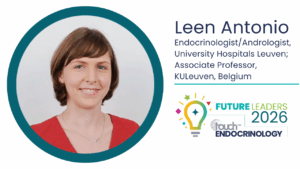
Dr Leen Antonio is an endocrinologist and andrologist at University Hospitals Leuven, Belgium, and Associate Professor in the Department of Chronic Diseases and Metabolism (CHROMETA) at KU Leuven. Her clinical and research interests focus on male hypogonadism, male infertility, pituitary disorders and steroid hormone biology. In recognition of her contributions to endocrine research, she received the Endocrine Society’s 2024 Early Investigator Award.
As a clinician-scientist, Dr Antonio combines specialist patient care with research investigating steroid hormone–binding protein interactions and their implications for improving the diagnosis and personalized management of endocrine disorders. In this interview, she reflects on the mentors who have shaped her career, the challenges of balancing clinical practice with research, and the legacy she hopes to leave through both her scientific contributions and the next generation of endocrinologists she helps to train.
New insights are added regularly, covering a broad range of subspecialties and evolving clinical scenarios. Sign up below for Free Access to the latest clinical updates in your specialty!
Can you tell us about a mentor who has significantly impacted your career?
During my PhD and clinical training, I had the opportunity to work with several very successful clinician-scientists, especially my research mentor Professor Dirk Vanderschueren. This convinced me to pursue an academic career and combine clinical care with research and teaching. Also working with Professor Frederick Wu from the University of Manchester has significantly impacted my career. They both taught me how to ask the right questions, challenged me when analyzing data and provided invaluable feedback on manuscripts. Currently, they keep supporting me, by exchanging ideas, providing advise on strategic decisions and supporting grant applications.
How do you balance clinical practice, research, and personal development?
As an endocrinologist and clinician-scientist, I combine patient care with clinically oriented research, with a focus on andrology, reproductive endocrinology and steroid hormones. More specifically, I do research on steroid hormone-binding protein interactions and clinical implications of looking at the total versus the free fraction, such as in the case of total testosterone, SHBG and free testosterone.
For me, combining clinical care with research is the biggest challenge. I run clinics in pituitary endocrinology, reproductive endocrinology and andrology and I’m also involved in our (para)thyroid clinics. I became a consultant endocrinologist about 7 years ago, and I’m still learning every day. As University Hospital Leuven is a teaching hospital, I am also engaged in clinical training of internal medicine residents and endocrinology fellows. This is very rewarding, but keeping up with new developments in all fields of endocrinology can be challenging.
As a researcher, I am PI of my own research group, investigating hormone-binding protein interactions. Finding enough time to write high-quality funding applications that are likely to get funded is challenging. However, I am convinced that cross-fertilization between the lab and the clinic is highly beneficial for patient care, both on a day-to-day basis in routine clinical care, as well as in the long run by increasing evidence-based diagnosis and treatment for frequent as well as rare endocrine diseases.
What legacy do you hope to leave in the field of endocrinology?
In endocrinology, I would like my legacy to be centered on bridging high-quality research data with meaningful clinical impact. Scientifically, I hope to contribute to a better understanding of androgen-protein interactions in a way that leads to improvements in diagnosing male hypogonadism and evidence-based personalized patient care.
Finally, I think an important part of legacy in academia is people. As a PI, I hope to train clinicians and researchers who can think critically, collaborate effectively, and pursue meaningful questions. If the people I’ve trained go on to contribute to the endocrinology field in their own way, I would consider that a very meaningful legacy.
More content in reprocuctive endocrinology.
Cite: Bridging endocrine research and patient care with Dr Leen Antonio: touchENDOCRINOLOGY Future Leader 2026. touchENDOCRINOLOGY. September 2026.
Disclosures: This short article was prepared by touchENDOCRINOLOGY in collaboration with Dr Leen Antonio. No fees or funding were associated with its publication.
Editor: Carla Junkier, Editorial Director.