We are delighted to feature Dr Rossella Cannarella as a touchENDOCRINOLOGY Future Leader 2026, recognized as an emerging leader in reproductive endocrinology.
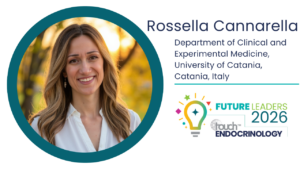
As part of the touchENDOCRINOLOGY Future Leaders 2026 series, we are pleased to feature Dr Rossella Cannarella, recognized for her contributions to endocrinology, andrology and reproductive health. Dr Cannarella is a Clinical Andrologist and Endocrinologist with over 15 years of training and research experience in male infertility, human reproduction and metabolic health. Her research focuses on male infertility, testicular function, sperm epigenetics and FSH treatment, with international research experience at Cleveland Clinic and the University of Massachusetts Medical School, USA.
In this interview, she reflects on what inspired her to pursue endocrinology, discusses the role of mentorship in shaping her career and highlights the importance of combining evidence-based medicine with individualised patient care. She also shares her passion for research and advice for the next generation of endocrinologists.
New insights are added regularly, covering a broad range of subspecialties and evolving clinical scenarios. Sign up below for Free Access to the latest clinical updates in your specialty!
What inspired you to pursue a career in endocrinology?
I was passionate about research from the age of 15. I knew I wanted to become a doctor and a researcher. But at that time, I didn’t know I was passionate about endocrinology. It was my professor at university who inspired me. When I attended the endocrinology classes, I was really inspired by the passion he put into the lessons. And this was the first spark.
Then I attended his clinics, and I had the opportunity to be involved in research projects and to work with patients under his supervision. Before that time, I had been outside the clinical and research environments. I just had one experience in the cardiology outpatient clinic, and it was nice, but it didn’t inspire me so much.
When I attended his clinic, I was struck by how much he listened to me. When I proposed research ideas, my professor, Professor Calogero, who is still my mentor 15 years later, was very supportive. It has been a wonderful journey, and he has helped me grow as both a researcher and an endocrinologist. He inspired me greatly. I had the opportunity to conduct research under his supervision from medical school. Being able to collect and analyze data from the very beginning was exciting and really exploratory.
From study to study, it was challenging because I had to learn so many things and overcome many obstacles. But it also helped me develop problem-solving skills and was incredibly rewarding. I would repeat it all from the very beginning; it has been a wonderful experience.
My professor was involved in research on male infertility, so I started in this field. I was involved in studies on male infertility and then proposed projects in reproductive endocrinology. After my PhD, I was invited to do a fellowship in the USA. I first went to Worcester, at Massachusetts Medical School, under Professor Randal’s supervision, who is a leading scientist in the field of sperm epigenetics and how paternal epigenetics can impact offspring health.
This is something very important because when you look at endocrinology and metabolic health, it is basically one of the major pieces of the puzzle. Reproductive endocrinology is somehow seen as something that is separate from metabolic health, while it’s not like that. I love the idea that reproductive endocrinology represents something that can help you to do prevention in the field of metabolic health and help patients to reach their metabolic goals. For example, 1 in 3 male patients with diabetes have low testosterone, which can affect their ability to reach their metabolic goals. Research also suggests that obese men may pass a predisposition to metabolic disorders to their offspring through sperm epigenetics.
Understanding the factors behind these processes is fascinating to me because, potentially, during the early developmental window, we can modify a man’s lifestyle, change these imprints and prevent their transmission to the offspring.
I’m very passionate about this field because you can combine clinical work, which is so important, with research that can be life-changing for patients. From a personal perspective, I also love the process of developing ideas, testing hypotheses and discovering whether they are correct. It’s like writing a story while observing it unfold, and ultimately sharing that story through publication. I find the whole process amazing.
What role do patients play in shaping how you approach treatments and make clinical decisions?
It’s fundamental that, of course, you apply an evidence-based approach when you treat your patient. So, it’s important to know the research findings and what the guidelines say, but this is not all because you also need to understand your patient. The patient is always a person, so you cannot just apply the guidelines. You have to understand their needs and desires.
Of course, you also have to explain the scientific evidence to the patient. In my clinic, what I do right now is make the patient aware of the evidence around their problem and the possibilities that we can achieve together to solve the issue. Together, we choose the best option for the patient.
The best option can be different from patient to patient because you have to consider many different factors, such as the economic aspect, intolerances, or many other issues. So, talking with the patient, understanding their history and considering their wishes is fundamental when you treat and care for them.
What advice would you give to medical students or young professionals considering a career in endocrinology?
For a student, I think it is very important to find a mentor because I see many environments where students would like to learn and do things, but they are not properly guided. So they feel like they are not oriented and do not know how to approach clinical or research work.
I was blessed to have someone who closely guided me and helped me understand the basics of clinical research, basic and in vitro research, as well as clinical practice. This was very important because it helped me understand how I could shape my own activities, both from a research and clinical point of view.
From my personal perspective, it is very important for a student to find a mentor who is passionate about the field. And for endocrinologists and professors, it is important to understand that the next generation is the future. We have a duty to pass on not only our knowledge but also our passion to the next generation because they will create the future.
I still work with my mentor, and it is wonderful because I always think that together you can achieve a lot of things that you cannot do alone. Being together is always a strength. At the same time, I have learned how to be completely independent in my field. This is the goal of mentorship: a mentor should help a student become completely independent in the field in which they are being mentored.
More content in reproductive endocrinology.
Cite: Shaping the future of reproductive endocrinology with Dr Rossella Cannarella: touchENDOCRINOLOGY Future Leader 2026. touchENDOCRINOLOGY. September 2026.
Disclosures: This short article was prepared by touchENDOCRINOLOGY in collaboration with Dr Rossella Cannarella. No fees or funding were associated with its publication.
Editor: Carla Junkier, Editorial Director.