We are delighted to feature Dr Maria Sofia Martinez-Cruz as a touchENDOCRINOLOGY Future Leader 2026, recognized as an emerging leader in endocrinology and cardiometabolic research.
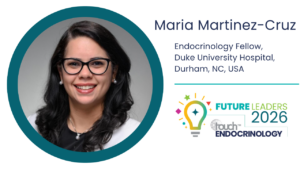
As part of the touchENDOCRINOLOGY Future Leaders 2026 series, we are pleased to feature Dr Maria Martinez-Cruz, an endocrinologist and physician-scientist at Duke University Medical Center, whose research focuses on cardiometabolic risk in underrepresented and diverse populations, with particular interests in lipoprotein(a) and hypertriglyceridemia. Originally from Maracaibo, Venezuela, she completed her medical training at the Universidad del Zulia and internal medicine training at MedStar Health-Baltimore, where she also served as Chief Resident. She is currently a third-year T32 Endocrinology fellow at Duke, pursuing a Duke Clinical Research Institute fellowship and a Master’s degree in Clinical Research. She has authored more than 40 peer-reviewed publications and was selected as an Endocrine Society 2026 FLARE scholar.
Committed to addressing cardiometabolic health disparities, Dr Martinez-Cruz is particularly interested in lipoprotein(a) and cardiovascular risk in diverse populations. In this interview, she discusses the mentors who shaped her career, how she balances clinical practice, research and personal development, and her hopes of advancing research while inspiring the next generation of physician-scientists.
New insights are added regularly, covering a broad range of subspecialties and evolving clinical scenarios. Sign up below for Free Access to the latest clinical updates in your specialty!
Can you tell us about a mentor who has significantly impacted your career?
It’s difficult to choose only one person; I have been lucky to have multiple mentors who shaped me both professionally and personally. However, I have to credit my mentors at the
Endocrine and Metabolic Research Center “Dr Félix Gómez” in Maracaibo, Venezuela: Dr Valmore Bermúdez, Dr Joselyn Rojas, and Dr Climaco Cano.
Dr Cano taught me the importance of training the next generation to keep moving knowledge and science forward, and instilled in me the habit of always being curious, always asking and
searching for the “why,” and aiming for excellence in every aspect of my work. Dr Bermúdez and Dr Rojas were central to my scientific formation. They taught me research methodology,
statistics, and the scientific method, and showed me how fun it is to be a physician-scientist and the positive impact we can have in the clinic and at the public health level. They also opened doors for me: I participated in multiple of their projects, getting hands-on training from design through execution and dissemination, which helped me become an established researcher very early on in my career.
How do you balance clinical practice, research, and personal development?
The honest answer is that there is never a real balance. Some days are mostly clinical, some mostly research, and some mostly personal development. Enjoying what I do and focusing
on solutions, positives, and the future definitely makes the difference.
What has helped most is being clear on my goals: who I want to be in 20 years and what I need to focus on to get there. I organize my time around that. Every week, I have nonnegotiable tasks that move me toward my goals. On non-clinical days, I dedicate time to writing, studying, and taking training courses to build the skills I want to develop. Most importantly, I have non-negotiable time for myself, family, and friends every week.
Small things done consistently build something giant. I have seen and learned this from my mentors at every stage of my training.
What legacy do you hope to leave in the field of endocrinology?
I strongly feel that physician-scientists coming from a disadvantaged background or a minority group have a unique opportunity to make a big impact on their communities that have historically been marginalized in research.
That’s why I want to focus my clinical and research work on clarifying some of the cardiometabolic risk factors that are most prevalent in these communities. I have a particular interest in the epidemiology of lipoprotein(a) in women, since levels can vary across different stages of a woman’s life, such as pregnancy and menopause. I hope to better understand this genetically determined cardiometabolic risk factor in these populations, in a way that could improve access to novel therapeutics and reduce their cardiovascular risk.
I also hope to continue the legacy my mentors passed on to me. They invested time and effort and gave me opportunities that changed my life and my career, and I hope to leave that same
mark on my current and future mentees, especially young Latina women like me. I want to show them that no matter where you’re from, your skin color, or your accent, hard work is
not ignored, and it will eventually pay off. So never give up.
More content in cardiovascular risk.
Cite: Dr Maria Martinez-Cruz on research, mentorship, and cardiometabolic health: touchENDOCRINOLOGY Future Leader 2026. touchENDOCRINOLOGY. September 2026.
Disclosures: This short article was prepared by touchENDOCRINOLOGY in collaboration with Dr Martinez-Cruz. No fees or funding were associated with its publication.
Editor: Carla Junkier, Editorial Director.