We are delighted to announce Dr Stéfanie Parisien-La Salle as a touchENDOCRINOLOGY Future Leader 2026, recognized for her emerging contributions to adrenal endocrinology and clinician-scientist research.
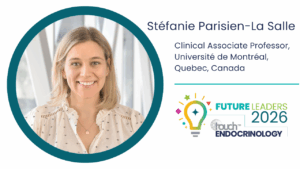
Dr Stéfanie Parisien-La Salle is an endocrinologist and clinician-scientist at the Centre hospitalier de l’Université de Montréal (CHUM), whose work focuses on adrenal disease and primary aldosteronism.
Dr Parisien-La Salle completed her endocrinology residency at the Université de Montréal, followed by a fellowship in adrenal disease genetics under the mentorship of Dr Isabelle Bourdeau at the CRCHUM. She subsequently undertook a postdoctoral research fellowship in primary aldosteronism at Brigham and Women’s Hospital, Boston, with Dr Anand Vaidya. She is currently completing both a PhD investigating the genetics of adrenal diseases and the Clinician-Scientist Program. Her research explores how tumour biology and systemic metabolic factors contribute to the heterogeneous clinical presentation of primary aldosteronism.
Drawn to endocrinology by its complex feedback systems and the wide-ranging effects of hormones throughout the body, Dr Parisien-La Salle combines clinical practice with research to advance understanding of adrenal disease. In this interview, she discusses the mentors who have shaped her career, her passion for adrenal research, and how research continues to inform her approach to patient care.
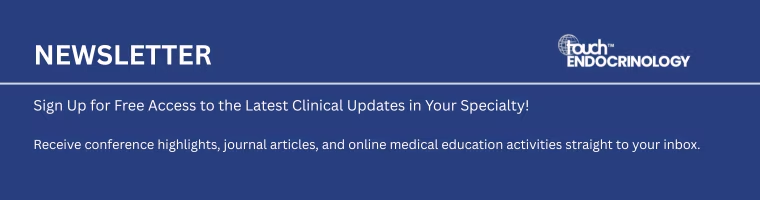
New insights are added regularly, covering a broad range of subspecialties and evolving clinical scenarios. Sign up below for Free Access to the latest clinical updates in your specialty!
What inspired you to pursue a career in endocrinology?
Honestly, it was the science that drew me in. I love the logic of the feedback loops and how a single hormone can have such multisystemic effects. That kind of integrative thinking really appealed to me, as there was always something new to understand.
That is exactly what made me choose adrenal as my subspecialty. They are complex, with real oncological and cardiovascular implications, so the stakes for patients are high. There is still so much we do not fully understand about adrenal physiology and disease, and I find that exciting and challenging.
Who has been the most significant mentor or role model for you, and what did you learn from them?
I have been lucky to have a few, and each of them shaped me in a different way. Dr Agnès Rakel showed me what it looks like to be a truly excellent clinician, the kind who is thoughtful and present with every patient. Dr Isabelle Bourdeau is the reason I fell in love with adrenal research, and she helped me see how the work in the lab translates right back to the people we care for. Dr Anand Vaidya showed me what was possible in this field and pushed me to keep raising the bar for myself.
What ties them together is that none of them separated rigorous science from good patient care. They taught me that the two are inseparable, and that is the kind of clinician and researcher I try to be.
What has been the most rewarding moment in your journey so far?
It is not really one defining moment for me. The most rewarding part happens in clinic, every day, when I see how my research actually deepens my understanding of my patients and helps me manage them better. That connection between the research and the patient is what makes the work feel worthwhile. It reminds me why I chose this field in the first place, and it keeps me motivated to keep asking questions.
More content in adrenal disorders.
Cite: Advancing the understanding of adrenal disease with Dr Stéfanie Parisien-La Salle: touchENDOCRINOLOGY Future Leader 2026. touchENDOCRINOLOGY. September 2026.
Disclosures: This short article was prepared by touchENDOCRINOLOGY in collaboration with Dr Parisien-La Salle. No fees or funding were associated with its publication.
Editor: Carla Junkier, Editorial Director.