Open Nav
Open Nav

Check your Inbox
We've sent your certificate

Thank you
for your Feedback!
Activity Overview
Faculty & Disclosures
Overview
Faculty & Disclosures

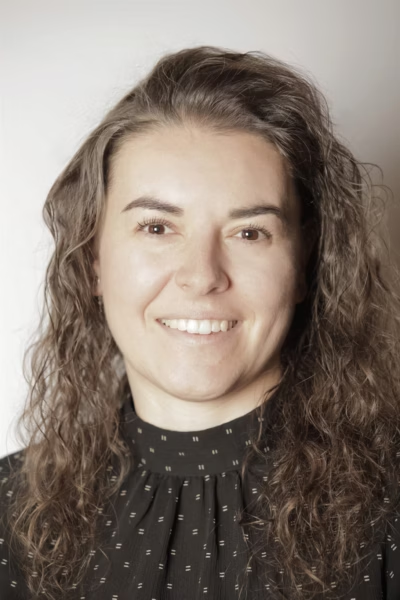
Dr Dessi Zaharieva
Stanford University – School of Medicine, CA
Biography
Dr Dessi Zaharieva is an exercise physiologist and Certified Diabetes Care and Education Specialist at Stanford University – School of Medicine. Her research focuses on the physiological and behavioural challenges of exercise in people with T1D, with a particular emphasis on AID systems and real-world technology use. She has led and contributed to multiple clinical studies and authored numerous peer-reviewed publications.
Disclosures
Speaker fees from Dexcom Inc., Ascensia Diabetes, Insulet Corporation and Medtronic. Advisory board fees from Diabetes Research Hub, Enhance-d and Tidepool (advisory member). Research support fees from Leona M. and Harry B. Helmsley Charitable Trust.

Dr Michael Riddell
York University, Toronto, Ontario

Dr Michael Riddell
York University, Toronto, Ontario
Biography
Dr Michael Riddell is a professor in the School of Kinesiology and Health Science at York University in Toronto, Canada. His work centres on the metabolic and hormonal responses to exercise in T1D, with extensive expertise in insulin pump therapy, continuous glucose monitoring, and AID research. He has collaborated widely on clinical trials, and contributed to international consensus statements on exercise and diabetes.
Disclosures
Speaker fees from Eli Lilly, Dexcom, Insulet and Novo Nordisk. Consulting fees from The Jaeb Center for Health Research, Insulet Inc., Dexcom, and Zucara Therapeutics. Stock options: Zucara Therapeutic.
Dr Dessi Zaharieva
Stanford University – School of Medicine, CA
touchFEATURE
This content is intended for healthcare professionals in Australia, Belgium, Canada, France, Germany, Israel, Italy, Kuwait, Netherlands, Nordics, Qatar, Switzerland, UAE & UK only
Please confirm that you are a healthcare professional in one of those countries.

This Activity Is Sponsored By Insulet.
Insulet provided financial support and video content, and has had input into the detailed project scope. This activity is provided by Touch Medical Communications (TMC) for touchENDOCRINOLOGY.
Close Popup
Could not verify Country/IP Address.
We were unable to verify your IP address, please try again later. If you are using a method to hide your IP address, such as a VPN or proxy, please disable this and try again.
This Activity Is Sponsored By Insulet.
Insulet provided financial support and video content, and has had input into the detailed project scope. This activity is provided by Touch Medical Communications (TMC) for touchENDOCRINOLOGY.

Unapproved products or unapproved uses of approved products may be discussed; these situations may reflect the approval status in one or more jurisdictions. TMC has advised the sponsor to ensure that they disclose any such references made to unlabelled or unapproved use. No endorsement by TMC of any unapproved products or unapproved uses is either made or implied by mention of these products or uses in TMC activities. TMC accepts no responsibility for errors or omissions.
The views and opinions expressed are those of the faculty and do not necessarily reflect those of any sponsor.
Date of preparation: April 2026
Log into your Touch Account
Keep track of your clinical interests and newsletter subscriptions.
Sign up with an Email
Or use a .
Register now for FREE access
Already registered? Login below.