
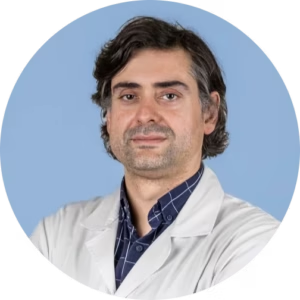
Dr Pedro Marques is a Consultant Endocrinologist at Hospital CUF Descobertas in Lisbon and an Assistant Professor and Researcher at the Medical Faculty of Católica University, also in Lisbon. He is an investigator at the Center for Endocrine Tumours at Leiden University Medical Center (LUMC), Netherlands, and currently serves as the Scientific Programmes Project Manager for the European Society of Endocrinology (ESE). Dr Marques is also the Vice President of the Portuguese Society of Endocrinology (2024–2027) and a Board Member of the ENEA Young Researchers Committee (EYRC).
After earning his medical degree from Faculdade de Medicina da Universidade do Porto in 2009, he completed specialist training in Endocrinology at the Portuguese Institute of Oncology Lisbon, alongside clinical fellowships at prestigious centres such as the Oxford Centre for Diabetes, Endocrinology and Metabolism (OCDEM) and Barts NHS Trust in London. He became a Board-Certified Endocrinologist in 2016 and completed his PhD at Queen Mary University of London in 2020, while maintaining clinical practice as a fellow at Barts Hospital. Following a clinical research fellowship at LUMC, he returned to Lisbon to continue his clinical and academic career.
Dr Marques’s research focuses primarily on pituitary tumours, particularly their tumour microenvironment, familial pituitary tumours linked to AIP mutations and pseudoacromegaly.
In this Future Leader Q&A, he discusses his clinical and research journey, the evolving landscape of pituitary tumour endocrinology, and the role of international collaboration in advancing endocrine science and patient care.
The mentor who has had the most significant impact on my career is undoubtedly Professor Márta Korbonits (William Harvey Research Institute, Queen Mary University of London, London, UK). Professor Korbonits welcomed me into her lab in 2016 and kindly agreed to supervise my PhD. She has always been incredibly supportive, offering guidance, sharing her knowledge, and providing constructive feedback and new ideas. Márta Korbonits is the kind of leader who leads by example: balanced, knowledgeable, hardworking, and consistently willing to support her fellows and colleagues.
Professor Korbonits encouraged me to take on responsibilities and taught me how to approach challenges strategically and independently, helping me to achieve my goals in science. I am truly grateful for her mentorship, support, and friendship over the years, and I am delighted that we continue to collaborate and work together on several projects.
As a pituitary-focused clinician-scientist, I would emphasize the ability to bridge the gap between patient care and scientific discovery, which ultimately advances the field of pituitary research and, hopefully, benefits patients worldwide. It is incredibly rewarding to take insights from the clinic, where I constantly encounter real unmet needs and unanswered questions from patients, and bring them to the bench and research arena. There, we can investigate these challenges, seek solutions and then translate our findings back to improve patient care. This translational aspect of research gives me a profound sense of purpose and continuity, and it motivates me to continue advancing my research in pituitary and neuroendocrinology.
Over the next decade, I believe some of the most significant advances in the field of pituitary tumours will arise from combining molecular diagnostics with personalized treatment approaches. In recent years, progress has been made in identifying genetic and epigenetic signatures that distinguish pituitary tumour subtypes and predict their behaviour and aggressiveness. Looking ahead, I anticipate a shift toward incorporating genomic and transcriptomic profiling into routine evaluation as these technologies continue to develop and become more accessible. This will improve our ability to consistently and accurately predict tumour behaviour, aggressiveness, and risk of recurrence, thereby guiding personalized treatment plans.
Regarding novel treatments and advances in patient management, especially for those with refractory or aggressive tumours, greater understanding of the molecular and biological drivers of pituitary tumours will likely lead to the emergence of more targeted therapies, including immunotherapies. Our knowledge of the immune microenvironment in pituitary tumours has been growing, which may enable the future identification of predictive biomarkers and, importantly, novel treatment strategies. Although checkpoint inhibitor drugs have already been used successfully to treat some aggressive or metastatic pituitary tumours, immunotherapy is still in its early stages for this disease.
A deeper understanding of the tumour microenvironment could open new avenues for developing additional immune-based therapies that ultimately improve clinical outcomes, quality of life, and survival for patients with refractory and aggressive tumours. Overall, the future management of pituitary tumours will become more personalized and biologically informed, with the integration of basic science, data science and clinical expertise playing a crucial role in driving this progress.
For those beginning their journey in Endocrinology, my first words would be: “Welcome to the best specialty in Medicine.” However, I would also advise them to be ready to work hard and to embrace the complexity, and often the unknown, that this field entails. Endocrinology is rooted in intricate hormone actions and feedback loops, with many scientific and clinical unmet needs across a wide range of endocrine diseases.
Since hormones influence virtually every organ and cell type in the body, endocrinologists (and endocrine researchers) must draw on broad experience in general medicine while also developing expert knowledge in specific endocrinopathies. This is emphasized in the Curriculum and Training Recommendation in Endocrinology by the European Society of Endocrinology, to which I had the great privilege to contribute.1
Moreover, the prevalence of endocrine disorder, especially obesity and diabetes, is increasing, which will lead to higher demand and workload for endocrinologists and endocrine scientists. Therefore, talented and dedicated professionals will be greatly needed in the future.
My two additional pieces of advice are:
- Find strong and supportive mentorship early in your career by seeking dedicated mentors at leading training centres.
- Collaborate widely, as some of the best training opportunities and most exciting advances in endocrinology come from interactions with colleagues and multidisciplinary interfaces with fields such as genetics, oncology, and immunology.
References
- Luger A, Durkan M, Christ-Crain M, Marques P. European Society of Endocrinology Curriculum and Training Recommendation in Endocrinology. Eur J Endocrinol. 2024;191(5):R71–7. DOI: 10.1093/ejendo/lvae141.
Disclosures: This short article was prepared by touchENDOCRINOLOGY in collaboration with Dr Marques. No fees or funding were associated with its publication.
Cite: Q&A with Dr Pedro Marques: touchENDOCRINOLOGY Future Leader 2025. touchENDOCRINOLOGY. August 21, 2025.
touchENDOCRINOLOGY is celebrating the brightest rising stars in the endocrinology community, who are set to shape the future of the field.
SIGN UP to touchENDOCRINOLOGY!
Join our global community today for access to thousands of peer-reviewed articles, expert insights, and learn-on-the-go education across 150+ specialties, plus concise email updates and newsletters so you never miss out.