
TouchENDOCRINOLOGY coverage from EASD 2025:
At the EASD 2025 congress (Vienna, Austria; 15–19 September), the management of diabetes in hospitalized patients, a group facing high risks and healthcare costs, received increasing attention. Poor glycaemic control in hospital is linked to longer stays, more complications, and worse outcomes.
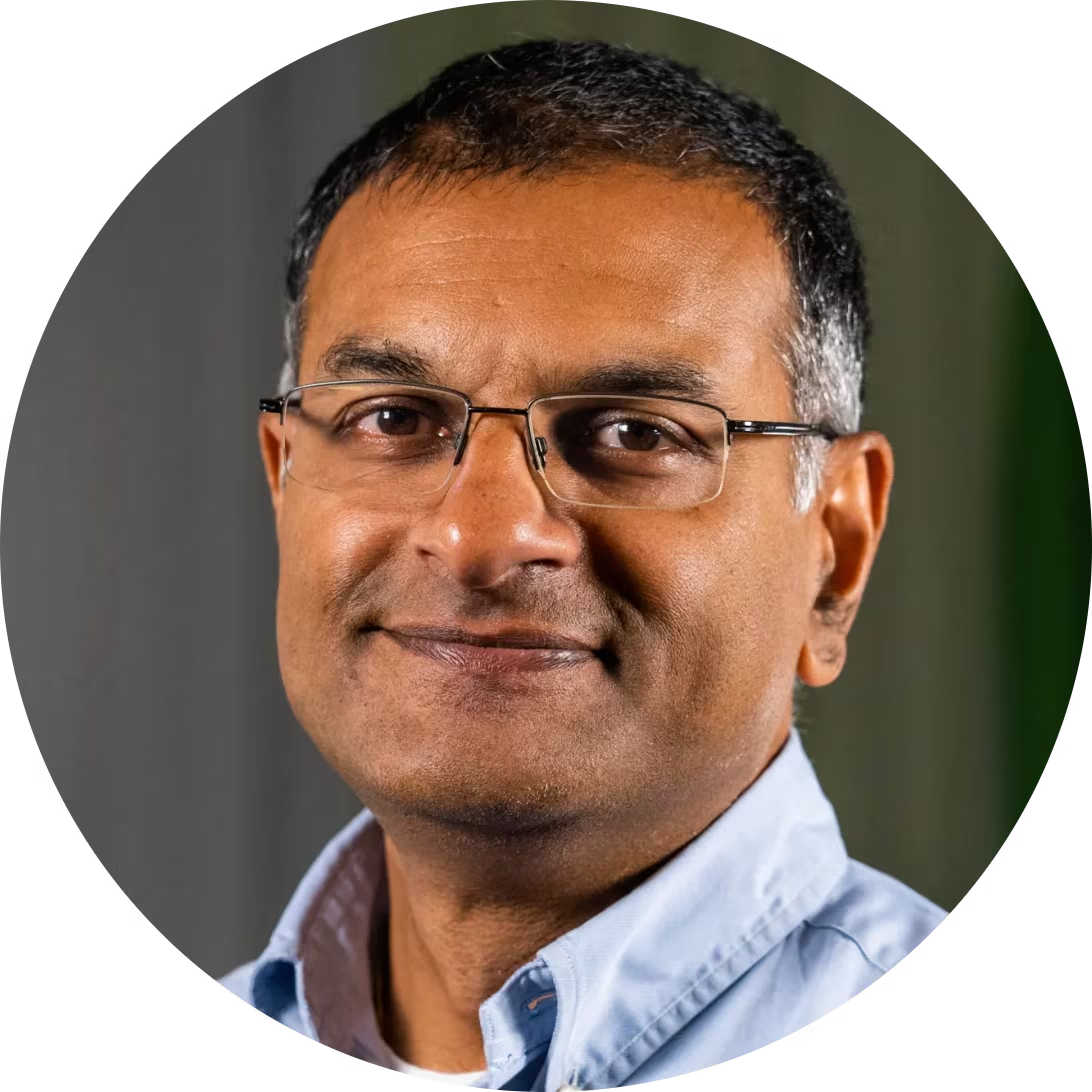
touchENDOCRINOLOGY spoke with Professor Ketan Dhatariya, Chair of the session “In-hospital diabetes management: characteristics and challenges,” which explored the potential of continuous glucose monitoring (CGM) and the current challenges and future directions in inpatient diabetes care.
In this interview, Professor Dhatariya discusses why inpatient diabetes is now a priority, the opportunities and barriers for CGM, and his vision for improving hospital care.
Q. Could you please give us a brief overview of the session and why in-hospital diabetes management is such an important focus at EASD this year?
I’ve been working in the field of inpatient diabetes for many years, and it’s increasingly clear, not only to scientific meetings like EASD but also to healthcare bodies such as NICE and government organizations, that inpatient diabetes, while affecting a relatively small proportion of the diabetes population, carries a disproportionately high cost.
The evidence consistently shows that people with diabetes who are admitted to hospital experience worse outcomes. That could mean longer hospital stays, poorer surgical outcomes such as infections and reoperations, or worse prognosis after events like heart attacks or strokes. More specifically, it’s often hyperglycaemia rather than diabetes itself that drives this increased risk.
The good news is that much of this harm is preventable through maintaining good glycaemic control during hospitalization. That’s why this area is getting more attention. EASD has included it this year, and earlier in 2025, ADA also dedicated a session to it. The focus is growing because the importance is undeniable.
Q. What are the potential benefits and challenges of implementing CGM in routine inpatient care?
That’s a good question. The main challenge is that CGM isn’t currently licensed for inpatient use. During COVID, manufacturers allowed hospitals to use these devices on a humanitarian basis, partly to reduce the need for bedside visits.
Traditionally, inpatients with diabetes require frequent finger-prick glucose checks. That has one unexpected benefit—nurses often pick up other problems while attending the bedside, such as spotting an infection, low blood pressure, or a patient looking unwell. Patients with diabetes therefore tend to have more glucose checks, and sometimes more timely interventions, than patients without diabetes.
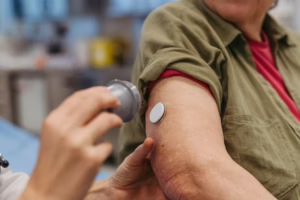
CGM changes that dynamic. It allows continuous monitoring without the need for repeated bedside tests, providing real-time data and alerts for hypo- or hyperglycaemia. This could enable earlier interventions and better safety.
But there are significant hurdles:
- Licensing and regulation: CGM is not approved for inpatient care.
- Practical use: Sensors last a couple of weeks, while many hospital stays are shorter—so what happens to the devices afterwards?
- Data access: CGM data is usually viewed on a patient’s phone or reader, not integrated into hospital systems. Feeding that information into electronic health records is a challenge.
- Staff training: Interpreting CGM data requires knowledge. Not all nurses or clinicians are familiar with glucose trends and what to do with them.
So, while the potential is huge, implementation will take time, infrastructure and education. But I believe we will get there.
Q. From your perspective, what are the biggest current obstacles hospitals face in maintaining good glycaemic control in patients with diabetes?
Unlike outpatients, people otherwise living in good health, hospitalized patients face a very different set of challenges. CGM has been shown to improve glucose control in outpatients because they can see their glucose values in real time and immediately understand what influences them.
In hospital, however, the situation is far more complex. Acute illness raises stress hormones and drives glucose up. Treatments such as steroids, being nil by mouth, intravenous fluids containing dextrose, or enteral and parenteral feeding all have major impacts on glucose levels.
At present, monitoring relies on intermittent finger-prick checks—perhaps hourly or every two hours for those on intravenous insulin. But even then, enormous fluctuations can occur between measurements.
This is where CGM offers real potential. It reveals the individual variation in glucose responses during acute illness, what I often call the “physiological trespass” of acute illness. Everyone’s response is different, but by tracking it continuously, CGM allows us to see and then intervene in ways that minimize dangerous glucose swings.
Q. What advances do you see as most promising, whether in technology, treatment protocols, or organization of care?
My dream is that any hospital patient at risk of hyperglycaemia could be started on a hybrid or fully closed-loop insulin delivery system. These systems adapt within hours and then maintain glucose automatically, relieving both staff and patients of constant monitoring and adjustments. Nurses would simply need to check the device, refill the insulin reservoir, and ensure its functioning correctly.
If the technology can safely manage glucose in real time, the result should be fewer complications and less harm. The barrier, of course, is cost, alongside the need for robust data to demonstrate efficacy in the inpatient setting. I believe we’ll reach that point, but it will take several years.
Q. What are the key take-home messages you hope clinicians and researchers will bring back from this session to their own practice?
The most important message is that there is still a lot of work to do, but it’s an exciting time. Inpatient diabetes management is increasingly recognized as an area of high unmet need and high cost, but also as an opportunity.
Technology is advancing rapidly, and when combined with thoughtful research and clinical practice, it has the potential to transform inpatient care. Funders are recognizing this too, because poorly managed inpatient diabetes is a drain on healthcare resources.
If we can generate the evidence, implement interventions, and optimize glucose control in hospitalized patients, we can improve outcomes and reduce costs. That’s the direction we need to move in.
About Professor Ketan Dhatariya
Professor Ketan Dhatariya is a Consultant in Diabetes, Endocrinology, and General Medicine at Norfolk & Norwich University Hospital and an Honorary Professor of Medicine at the University of East Anglia. A full-time clinician, his primary interests are inpatient diabetes care—including peri-operative management, diabetes-related emergencies, and diabetic foot disease—and he leads one of the largest foot clinics in the East of England. He holds several national and international roles, including Chair of the Association of British Clinical Diabetologists, Immediate Past Chair of the Joint British Diabetes Societies Inpatient Care Group, and Chair of the Examining Board for the UK Specialist Clinical Exam in Diabetes and Endocrinology. He was also the inaugural Chair of the European Board Examination in Endocrinology, Diabetes, and Metabolism, a former President of the Diabetes and Endocrine Section of the Royal Society of Medicine.
This content has been developed independently by Touch Medical Media for touchENDOCRINOLOGY. It is not affiliated with the European Association for the Study of Diabetes (EASD). Views expressed are the speaker’s own and do not necessarily reflect the views of Touch Medical Media.
 A Clinical Review of Continuous Glucose Monitoring in the Hospital Setting